

Building Management Systems (BMS) in Oman

Design, integration, commissioning and maintenance of building management and automation systems – for buildings in Muscat, Sohar, Salalah and Duqm. Your chillers, AHUs, pumps, lighting and generators are probably running on their own local controls, on schedules set years ago, with nobody watching them between complaints. That is how buildings in Oman quietly overspend on electricity, wear out plants early, and only discover a failure when a guest or a ward calls to say it is hot.

A building management system puts all of it on one screen, on one set of rules, with alarms that reach a person before an occupant does. Lyqa Tech Ventures SPC designs, installs, integrates and maintains BMS and building automation systems across Oman – new builds and retrofits, single buildings and multi-site portfolios.

Why BMS economics are different in Oman

The Cost-Reflective Tariff:

you are billed for your peak, not just your energy

Government, commercial and industrial customers in Oman consuming above 100 MWh per year fall under the Cost-Reflective Tariff (CRT), approved by the Council of Ministers and regulated by the Authority for Public Services Regulation. Unlike a flat subsidised rate, the CRT is assembled from several components - an hourly energy charge, a transmission charge applied to your contribution to system peak demand, a distribution charge per kWh, and a supply charge. Read that second component again, because it changes the brief entirely.

Climate - What Muscat, Sohar, Salalah and Duqm each do to plant

The Ministry of Housing and Urban Planning, working with the International Code Council, has issued the Oman Building Code framework - a coordinated 2025 package of technical codes covering building design, mechanical, plumbing, existing and historic buildings, and, critically for this discussion, the Oman Energy Efficiency and Sustainability Code (OEESC), which regulates energy efficiency, sustainability and building energy performance.

Muscat - long, severe cooling season and dense high-rise/hospitality stock. The wins are in chiller plant optimisation and in not letting a building run 24/7 cooling on a 1990s time clock.

Sohar and Duqm - industrial, coastal, salt-laden air. Field devices, panel enclosures and rooftop sensors need appropriate IP and corrosion ratings, or you will be replacing them in year two. Panel gland plates and enclosure selection matter as much as the software.

Salalah - the khareef changes the problem from pure cooling to humidity and dew point control. A control strategy tuned for Muscat's dry heat will produce mould complaints in Salalah if it is copy-pasted. Dehumidification sequences and fresh-air handling need to be designed for the season, not inherited.

The Oman Building Code and the Energy Efficiency & Sustainability Code

The Ministry of Housing and Urban Planning, working with the International Code Council, has issued the Oman Building Code framework - a coordinated 2025 package of technical codes covering building design, mechanical, plumbing, existing and historic buildings, and, critically for this discussion, the Oman Energy Efficiency and Sustainability Code (OEESC), which regulates energy efficiency, sustainability and building energy performance.

For owners, the practical consequence is that energy performance is moving from optional good practice to documented requirement, and that controls - scheduling, zoning, metering, lighting control - are the cheapest way to demonstrate it. Existing stock is not exempt from the direction of travel: Oman's national retrofit push has been explicit about targeting existing government buildings first, with the Oman Net Zero Centre describing a phased government retrofit programme aimed at 26% savings.

We are not a code-consultancy and we will not tell you your project is compliant - your engineering office signs that off. What we will do is engineer the controls, metering and reporting layer so that compliance is demonstrable rather than argued.

projects usually fail Fire alarm systems

What we do

New-build BMS design, supply and installation

Working from the consultant's specification and drawings: point list and IO schedule development, controller and field-device selection, technical submittals, control panel design and build, containment and cabling coordination with the MEP contractor, software configuration, graphics, commissioning and witnessed testing, as-built documentation and operator training.

Retrofit and legacy system takeover

Existing buildings, existing plant, and often an existing BMS that has stopped being maintained. We survey what is physically there, tell you honestly what can be reused, and phase the work so the building keeps running. Where a previous system is proprietary and orphaned, we will say so plainly and price the options - head-end replacement, gateway integration, or staged controller replacement - rather than pretending everything is salvageable.

Integration with your existing ELV and IT systems

BMS rarely lives alone. We integrate chiller and generator controllers, energy and BTU meters, lighting control, access control, CCTV, guest room management, and IT/network monitoring - using open protocols wherever the equipment supports them.

Maintenance, monitoring and optimisation

Preventive maintenance visits, alarm review and tuning, sensor calibration, graphics and schedule changes as the building's use changes, software updates, and periodic performance review against your actual consumption data.

Building Management Systems

What a BMS Actually Controls

A BMS, also called a Building Automation System (BAS), connects controllers and sensors to a central supervisory platform to monitor, control, record, and alarm building systems.

System What the BMS Does
Chillers, AHUs, FCUs, VAVs
Sequencing, scheduling, setpoint reset, run-hour balancing, filter and fault alarms
Pumps and Cooling Towers
Duty/standby rotation, VSD control, dry-run and flow protection
Lighting
Time, occupancy and daylight control by zone; common-area and façade scheduling
Electrical
Incomer, feeder and sub-metering; generator and UPS status; load shedding
Water
Tank levels, booster pump status, leak detection, BTU/chilled-water metering
! Life Safety & Security
Monitoring and status only — see the fire alarm section below
Lifts, Car Park & Exhaust
Status, fault reporting, CO-linked ventilation control
← Swipe left/right →   to view the full table

Who we build these systems for

Hotels and hospitality fire alarm systems

Hotels and resorts

plant room control plus guest room management, so unoccupied rooms are not cooled to 20°C for three weeks

Warehouses, logistics and industrial fire alarm systems

Hospitals and clinics

critical-area temperature, humidity and pressure monitoring, plant redundancy, alarm escalation, auditable logs
Hospitals and healthcare fire alarm systems

Government and institutional buildings

retrofit-led projects where metering and reporting are as important as control
Hotels and hospitality fire alarm systems

Retail and malls

long operating hours, high fresh-air loads, food-court exhaust and make-up air balance
Warehouses, logistics and industrial fire alarm systems

Industrial and logistics facilities

Sohar, Duqm and SEZAD sites where corrosion, dust and process cooling drive the design
Hospitals and healthcare fire alarm systems

Data centres and technical rooms

cooling redundancy, environmental monitoring, integration to DCIM
How a BMS project runs with us - stage by stage

Site survey and requirement capture

We walk the plant rooms, list what is physically installed, and record what protocols the existing equipment speaks. For a tender, we work from the consultant's drawings and specifications.

Points list, IO schedule and control philosophy

Everything that will be monitored or controlled, and the sequence of operation for each system. This is the document that determines the price and the outcome - we agree to it with you before anything is ordered.

Technical submittal and approval

Controllers, field devices, panel drawings, network architecture, cause-and-effect matrix, submitted for consultant and client approval.

Supply, panel build and installation

Panel fabrication and factory testing, field device installation, network cabling, coordination with the MEP and electrical contractors.

Configuration, graphics and commissioning

Controller programming, point-to-point verification, loop tuning, alarm configuration, graphics build to your floor plans and schematics.

Witnessed testing, handover and training

Formal testing against the approved cause-and-effect matrix, as-built documentation, O&M manuals, operator and engineer training, and a defined defects-liability period.

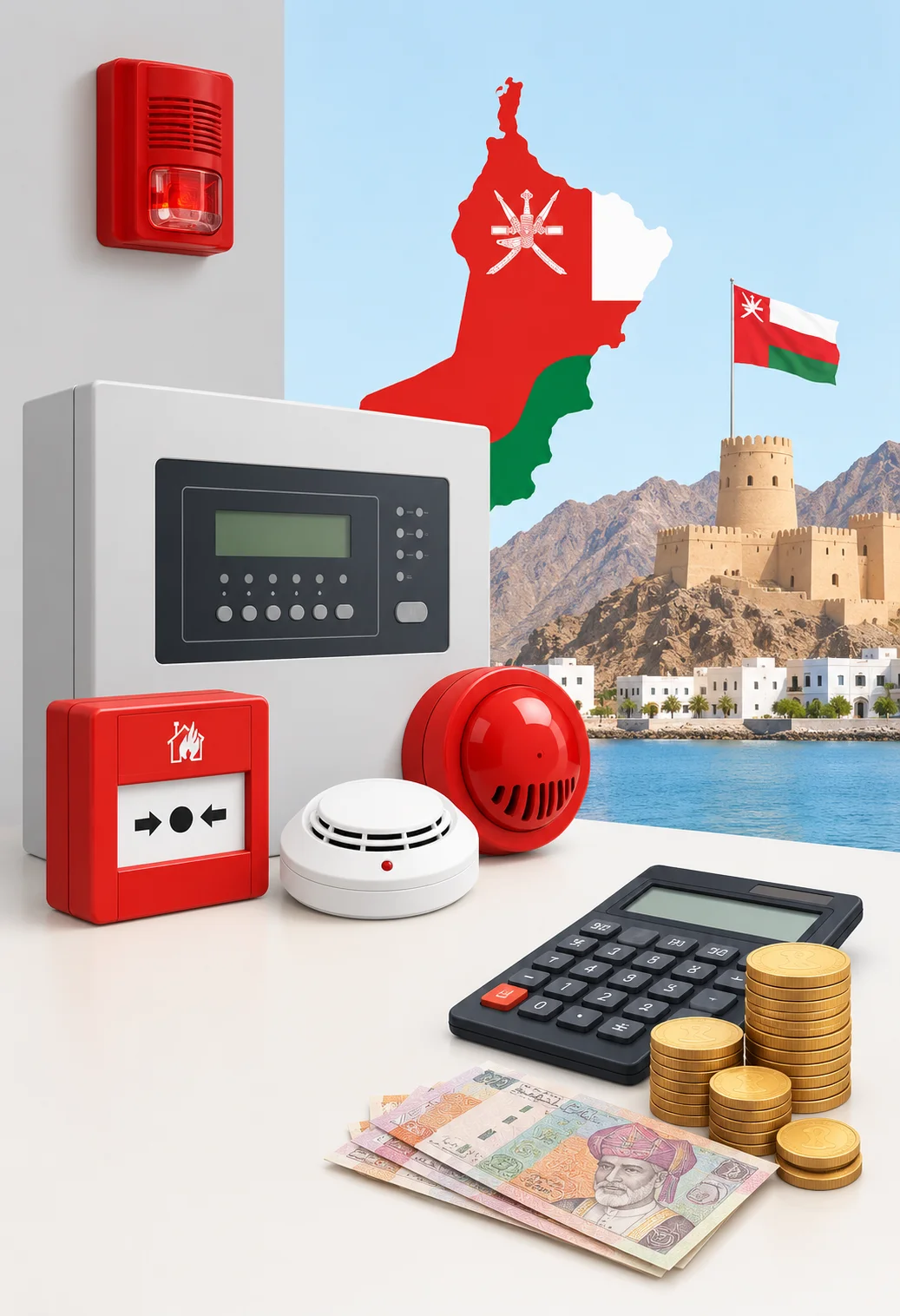
What drives the cost of a BMS in Oman

We do not publish fixed prices, because a BMS is priced from a points list, not from a building's floor area. Two 10,000 m² buildings can differ by a factor of three depending on what is being controlled.

The variables that actually move the number:

Point count - the total of monitored and controlled inputs and outputs. This is the primary driver.

Controller count and distribution - how many plant rooms, floors and risers need field panels, and how far apart they are.

Integration count - every third-party system (chillers, generators, meters, lighting, GRMS, access control) adds gateway hardware, mapping and testing effort.

Cabling and containment - a retrofit through an occupied, finished building costs far more per point than a new build with open ceilings.

Graphics and reporting scope - a plant-room schematic is quick; sixty floor plans with tenant-level dashboards is a project of its own.

Commissioning and witnessed testing days - driven by point count and by how formal the client's acceptance process is

Ongoing support level - response time, visit frequency, spares holding and out-of-hours cover.

drives the cost of a fire alarm system in Oman

Get a BMS proposal for your building

Send us drawings, a specification or a points list - or simply tell us what your building is and what is going wrong. We will arrange a site survey, agree the control philosophy with you, and quote against a documented scope rather than a guess.

Why Lyqa Tech Ventures

We are an Oman company, on the ground. Not a regional office quoting from another country.

BMS sits inside a wider ELV (Extra Low Voltage) and IT capability. Building automation, security systems, networking and cybersecurity are engineered by one team, so the integrations between them are designed rather than negotiated between vendors after the fact.

We will tell you what not to buy. Points you do not need, integrations that will not pay back, graphics scope that will not be used.

Open by default. Published protocols, documented configuration, and a system you own.

Where we work

We deliver and support BMS projects across Oman: Muscat (including Ghala, Seeb, Al Khuwair and Ruwi), Sohar and the Sohar Port and Freezone area, Salalah, and Duqm / SEZAD.

Our Clients

Request a Building Management Systems (BMS) site survey

Tell us the building type, approximate floor area and whether you have an existing system, and we will tell you what your building actually needs before we quote anything.

Frequently Asked Questions

What is the difference between a BMS and a BAS?

None that matters commercially. Building Management System and Building Automation System describe the same thing. “BMS” is more common in Oman and the wider GCC; “BAS” is more common in North America. Some specifications use “BMS” for the supervisory layer and “BAS” for the field controls, but this is not a universal distinction.

Yes, and most of our enquiries are retrofits. The constraints are physical – cable routes through finished ceilings, plant that must stay running, and existing equipment that may or may not speak an open protocol. We survey first and phase the work so the building keeps operating.

Usually. It depends on whether the existing system uses open protocols and whether the configuration and documentation still exist. We will survey it and give you three costed options: maintain as-is, integrate behind a new head end, or stage a replacement. We will tell you honestly if the first option is not viable.

No. The fire alarm system is a standalone life-safety system approved under the applicable fire code and CDAA requirements, and its logic must not depend on the BMS. The BMS monitors fire alarm status through a supervised interface so operators have a single view. Fire-mode HVAC responses are executed by the fire alarm system’s own approved cause-and-effect logic.

It is priced from the points list, not from floor area. The drivers are point count, controller count, number of third-party integrations, cabling difficulty, graphics scope, commissioning days and the support level you want. Send drawings or a specification and we will quote them.

We will not give you a percentage before we have seen your building – and you should be sceptical of any supplier who does. Savings depend entirely on how the plant is operated today. What we will do is meter the baseline, agree the strategies that apply to your plant, and report measured results afterwards.

BACnet/IP, BACnet MS/TP, Modbus RTU and TCP, and M-Bus for metering, with gateways for third-party equipment such as chillers, generators, lighting control and guest room management.

Yes. Tell us the site location and we will confirm response times and site-visit arrangements for that governorate before the contract.

Typically: scheduled preventive visits, sensor calibration checks, alarm review and tuning, schedule and setpoint changes, software updates, fault attendance within an agreed response time, and a periodic performance report. Scope and response times are set in the contract – we do not use a single fixed package.

Get in Touch

Our vision is to be Oman’s trusted partner for digital transformation.


Mail Us :

sales@lyqatech.com

Phone Us :

+968 9855 0383

lyqatech Contact Form