
Enterprise AI Infrastructure Solutions in Oman
Build a powerful foundation for enterprise AI with high-performance GPUs, AI servers, intelligent storage, high-speed networking, and integrated computing systems. Lyqa Tech helps businesses explore AI infrastructure options designed around their workloads, performance requirements, and deployment environments.
From compact AI workstations and NVIDIA DGX Spark to enterprise GPU servers, HGX platforms, and rack-scale AI systems, we help organizations plan the infrastructure needed to develop, deploy, and scale AI applications.
When a Business in Oman Is Ready for AI Infrastructure
The Goal Is Capability. The Foundation Is Infrastructure.
Enterprise AI requires more than a powerful processor. It needs the right combination of computing power, memory, storage, networking, and supporting infrastructure to operate effectively.
Lyqa Tech brings together AI infrastructure options for businesses looking to run AI workloads locally, build private AI environments, support demanding computing applications, and prepare for future expansion.
Whether your organization is starting with a compact AI workstation or planning a larger GPU computing environment, the right infrastructure begins with understanding your requirements.

AI Infrastructure Must Work as One Connected System
Selecting individual hardware components without considering the complete architecture can create performance bottlenecks, compatibility problems, and unnecessary costs.
Enterprise AI environments need computing, memory, storage, and networking to work together efficiently.
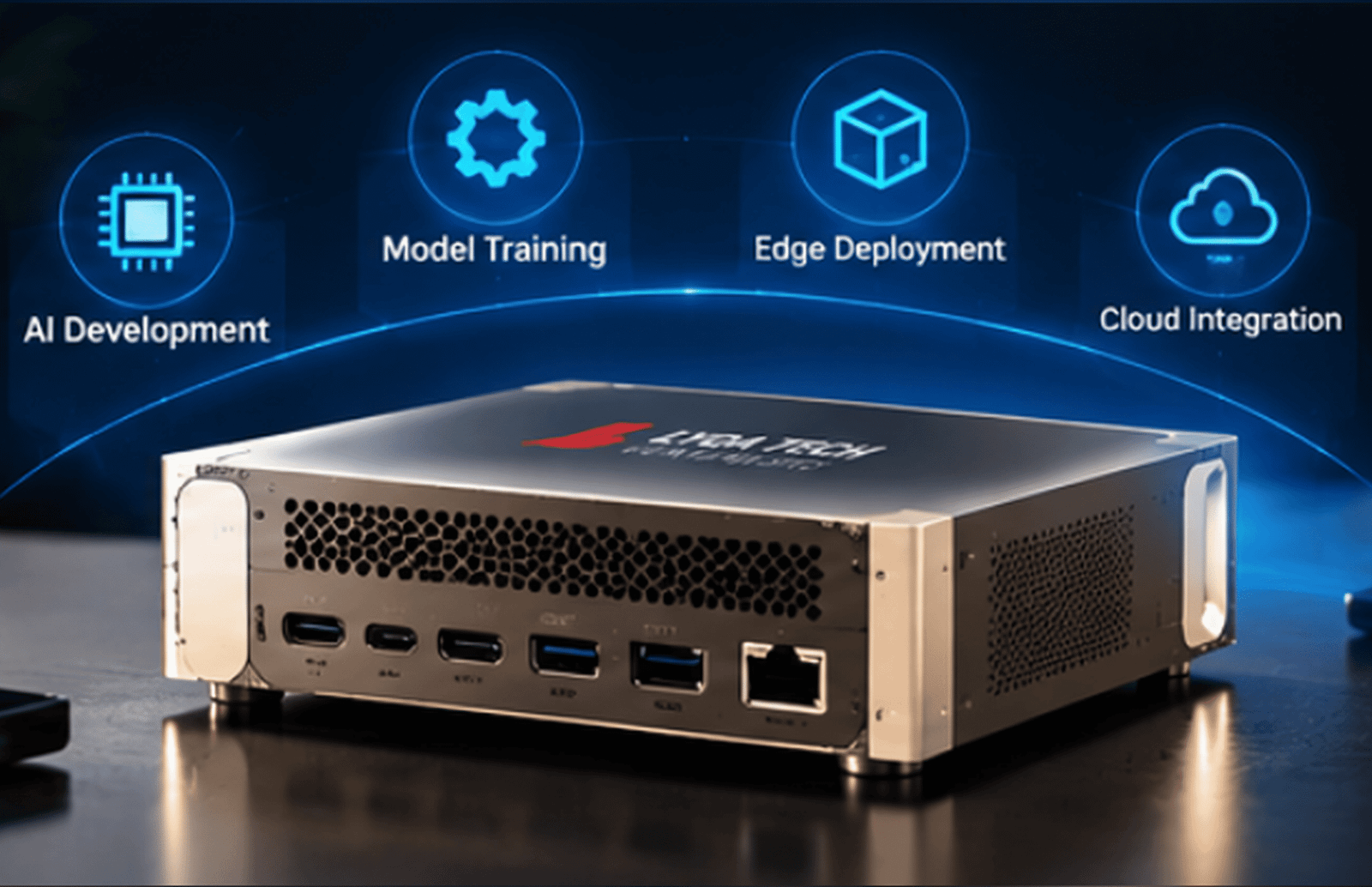
Build Beyond Individual Hardware
A GPU alone does not make a complete AI platform. The surrounding infrastructure determines how effectively data reaches the GPU, how workloads communicate, and how the system can grow.
Lyqa Tech's AI infrastructure portfolio brings together hardware categories that support the development of connected AI computing environments.
Key considerations:
Select GPU computing platforms based on workload requirements.
Match system memory and GPU memory to application demands.
Design storage around data capacity, throughput, and access patterns.
Choose networking technologies that fit the required performance and architecture.
Plan power, cooling, compatibility, and future expansion from the beginning.
From AI Hardware Components to Complete Infrastructure
AI infrastructure is a combination of interconnected technology layers. Each layer plays a role in delivering reliable computing performance.
GPU accelerators, AI workstations, GPU servers, HGX platforms, and DGX systems provide the computing foundation for demanding AI workloads.
DDR5 ECC server memory and enterprise NVMe SSDs support active computing workloads, model storage, datasets, and high-performance data access.
InfiniBand, RoCE Ethernet, network adapters, switches, and optical transceivers connect computing and storage resources across AI environments.
Integrated platforms and rack-scale architectures combine computing, interconnects, and supporting infrastructure for larger deployments.

Enterprise AI Infrastructure Capabilities We Deliver
Enterprise Memory and Storage
Identify DDR5 ECC RDIMM memory, enterprise NVMe SSDs, and storage platforms suited to demanding data-intensive applications.
Build the Right Foundation for Your AI Strategy
From a single AI workstation to a multi-GPU computing environment, the right infrastructure begins with a clear understanding of your requirements.
AI Infrastructure by Workload
SPECIALIZED AI INFRASTRUCTURE APPLICATIONS:
Run trained AI models to generate responses, analyze information, process images, and support business applications. Infrastructure requirements depend on model size, concurrent users, latency targets, and expected throughput.
Support AI development environments that require suitable GPU computing, system memory, fast storage, and compatible software. Fine-tuning requirements vary according to the model, training method, and dataset.
Explore multi-GPU servers, HGX platforms, high-speed interconnects, and integrated computing systems for workloads that require substantial parallel processing.
Explore compact AI systems and on-premises computing options for organizations seeking greater control over their computing environment, data placement, and deployment architecture.
Support data-intensive workloads with enterprise storage and high-performance networking designed around dataset size, access patterns, and application requirements.
Explore suitable professional GPUs and computing systems for visualization, engineering, simulation, and other accelerated applications.
Explore Our AI Infrastructure Portfolio
Choose infrastructure according to the workload, deployment environment, and performance requirements of your organization.
| ▦ Product Category | ⚙ Solutions & Technologies | ◎ Primary Application |
|---|---|---|
|
▣
Compact AI Systems
|
NVIDIA DGX Spark and other compact AI platforms | Local AI development and selected inference workloads |
|
▤
Professional AI Workstations
|
DGX Station and compatible workstation platforms | AI development, professional computing, and research |
|
▥
GPU Accelerators
|
NVIDIA A100, H100, H200, L40S, and RTX Pro families | AI inference, training, visualization, and accelerated computing |
|
▦
GPU Servers
|
2-GPU, 4-GPU, 8-GPU, and other compatible server configurations | Enterprise AI and high-performance computing (HPC) workloads |
|
▧
HGX Platforms
|
HGX H200, B200, B300, and other applicable configurations | High-density, multi-GPU computing |
|
▤
Enterprise Memory
|
DDR5 ECC RDIMM | Server memory capacity and reliability |
|
▣
Enterprise Storage
|
NVMe SSDs, Huawei Dorado, and DDN platforms | Model data, datasets, databases, and shared storage |
|
⌁
AI Networking
|
NVIDIA Quantum-2 InfiniBand, H3C RoCE Ethernet, ConnectX adapters | High-speed communication between computing resources |
|
▦
Rack-Scale AI
|
NVIDIA GB200 NVL72 and other compatible integrated systems | Large-scale AI computing environments |
AI Infrastructure for Enterprise Industries Across Oman
Different industries require different combinations of computing performance, storage capacity, network connectivity, and operational controls.

Financial Services

Energy and Industrial Operations

Healthcare and Life Sciences

Education and Research

Government and Large Enterprises
How a Lyqa Tech AI Infrastructure Project Runs
Understand Your Requirements
We begin by identifying your intended AI applications, workloads, model requirements, performance targets, budget, and deployment environment.
Define the Infrastructure Architecture
We identify suitable computing platforms, GPU configurations, memory, storage, and networking options based on the requirements established during discovery.
Validate Compatibility
The proposed components must be checked for hardware compatibility, software support, power requirements, cooling, networking, and the intended operating environment.
Develop the Solution Proposal
The proposed solution defines the relevant hardware categories, intended architecture, configuration assumptions, and commercial requirements.
Plan Deployment
The deployment plan addresses infrastructure readiness, physical installation requirements, connectivity, software configuration, and validation appropriate to the agreed scope.
Validate and Prepare for Expansion
The completed environment should be tested against agreed acceptance criteria, with performance, operational requirements, and future expansion considered as appropriate.
Talk to Us About Your AI Infrastructure Requirements
Planning a new AI environment or upgrading existing computing infrastructure? Discuss your workload, hardware requirements, deployment plans, and infrastructure priorities with Lyqa Tech.
What Drives the Cost of AI Infrastructure in Oman?
The cost of an AI infrastructure project depends on the complete system configuration, not just the price of a GPU.
GPU Selection and Computing Capacity - GPU model, memory capacity, GPU count, and interconnect requirements can significantly affect the overall hardware investment.
Server Configuration - CPU selection, system memory, PCIe expansion, chassis design, power supplies, and cooling requirements influence server configuration and cost.
Storage Requirements - Storage capacity, drive type, redundancy, throughput, and shared-access requirements affect the design and cost of the storage environment.
Networking Architecture - Switches, adapters, optical transceivers, cables, network topology, and required link speeds contribute to the overall infrastructure cost.
Power and Cooling - High-performance computing systems require appropriate electrical capacity and heat management. Large GPU deployments may require specialized cooling and facility preparation.
Software and Deployment - Software licensing, installation, integration, validation, technical support, and ongoing operational requirements should be included in the total project assessment where applicable.
Scalability and Future Expansion - A design that accommodates expected growth may require additional initial investment but can help avoid costly redesigns later.

Designing AI Infrastructure for Omani Business Conditions
Enterprise infrastructure should be selected according to the organization's operating environment, technical requirements, and long-term objectives.
Deployment Flexibility
Environmental and Facility Readiness
Data Governance and Security
Long-Term Infrastructure Planning
Why Choose Lyqa Tech for Enterprise AI Infrastructure?
Workload-Focused Recommendations - Infrastructure decisions should begin with the AI workload and required outcomes, not a predetermined hardware product.
Broad Infrastructure Coverage - Explore computing, GPU acceleration, server memory, enterprise storage, and high-speed networking within one infrastructure portfolio.
Architecture-Led Planning - Consider the relationships between computing, storage, networking, power, and cooling before finalizing the proposed configuration.
Flexible Deployment Options - Explore compact AI systems, professional workstations, GPU servers, integrated platforms, and rack-scale solutions.
Compatibility-Conscious Design - Prioritize verification of product specifications, hardware compatibility, operating requirements, and vendor support before committing to a configuration.
A Foundation for Future Growth - Plan infrastructure around current requirements while considering how capacity, workloads, and operational needs may change over time.
Our Clients





Ready to Build Your AI Infrastructure?
From compact AI computing systems to integrated enterprise GPU environments, Lyqa Tech can help you define the infrastructure options that align with your workload and deployment requirements.
Frequently Asked Questions About AI Infrastructure
What is AI infrastructure?
AI infrastructure is the combination of computing hardware, GPUs, memory, storage, networking, and supporting systems required to develop, train, deploy, and operate AI applications.
What AI infrastructure solutions does Lyqa Tech cover?
The portfolio covers compact AI systems, professional workstations, GPU accelerators, GPU servers, HGX and DGX platforms, enterprise memory and storage, high-speed networking, and rack-scale AI systems.
What is the difference between NVIDIA DGX Spark, DGX systems, and HGX platforms?
DGX Spark is a compact AI computing system intended for local AI workloads. DGX systems are integrated NVIDIA AI computing platforms. HGX is a multi-GPU platform used in compatible server designs. Their capabilities and deployment requirements differ significantly.
Which GPU is suitable for enterprise AI?
The right GPU depends on the model, workload, memory requirements, performance targets, software compatibility, and budget. Options in the portfolio include A100, H100, H200, L40S, and professional RTX Pro products.
What is the difference between AI inference and AI training?
Inference uses an existing trained model to generate outputs. Training adjusts model parameters using data and generally involves different computing and memory requirements. Fine-tuning adapts an existing model to a particular task or dataset.
Why is GPU memory important for AI?
GPU memory holds model weights, intermediate data, and other information needed during computation. Insufficient memory can restrict the size of a model, context length, batch size, or the workloads that can run on a system.