

Continuous Integration and Continuous Deployment Services in Oman

Still pushing releases by hand, or maintaining a CI/CD setup that only one engineer really understands? Lyqa Tech Ventures SPC designs, builds and supports Continuous Integration and Continuous Deployment pipelines for businesses across Oman – from a two-person dev team shipping a single product to an organization running multiple applications across separate environments.

We work with your existing tools rather than replacing them, and one team stays accountable from the first assessment through to ongoing pipeline support.

Why CI/CD matters for growing teams in Oman

As more businesses in Oman build and maintain their own software - internal systems, customer platforms, mobile apps - release reliability becomes a real operational risk, not just a developer inconvenience. A missed step in a manual deployment can take a customer-facing service down, and it usually happens at the worst possible time.

Two things tend to force the issue:

CI/CD matters for growing teams in Oman

Team growth outpaces the process

A process that worked for one developer breaks down once three or four people are pushing changes to the same environments without a shared, automated release path.

Team growth outpaces the process - Continuous Integration and Continuous Deployment (CI/CD)

Customers expect uptime

Whether it's an e-commerce platform, a booking system, or an internal tool a whole department depends on, unplanned downtime from a bad deployment has a direct business cost.

CI/CD doesn't remove the need for good engineering - it removes the need to rely on any one person remembering every step correctly, every time.

Where Pipelines Usually Fail

In our experience, teams rarely fail because they have no automation - they fail because the automation is incomplete or unmaintained. The most common patterns we see:

  • Tests exist but aren't actually run before deployment, so broken code reaches production anyway
  • Deployment credentials are stored insecurely, or shared across too many people
  • There's no defined rollback step, so a bad release becomes a multi-hour incident
  • The pipeline was built by one person who has since left or moved teams, and no one else can safely change it
  • Staging and production environments have quietly drifted apart, so "it worked in staging" stops meaning anything

CI/CD services we provide

Pipeline design and setup

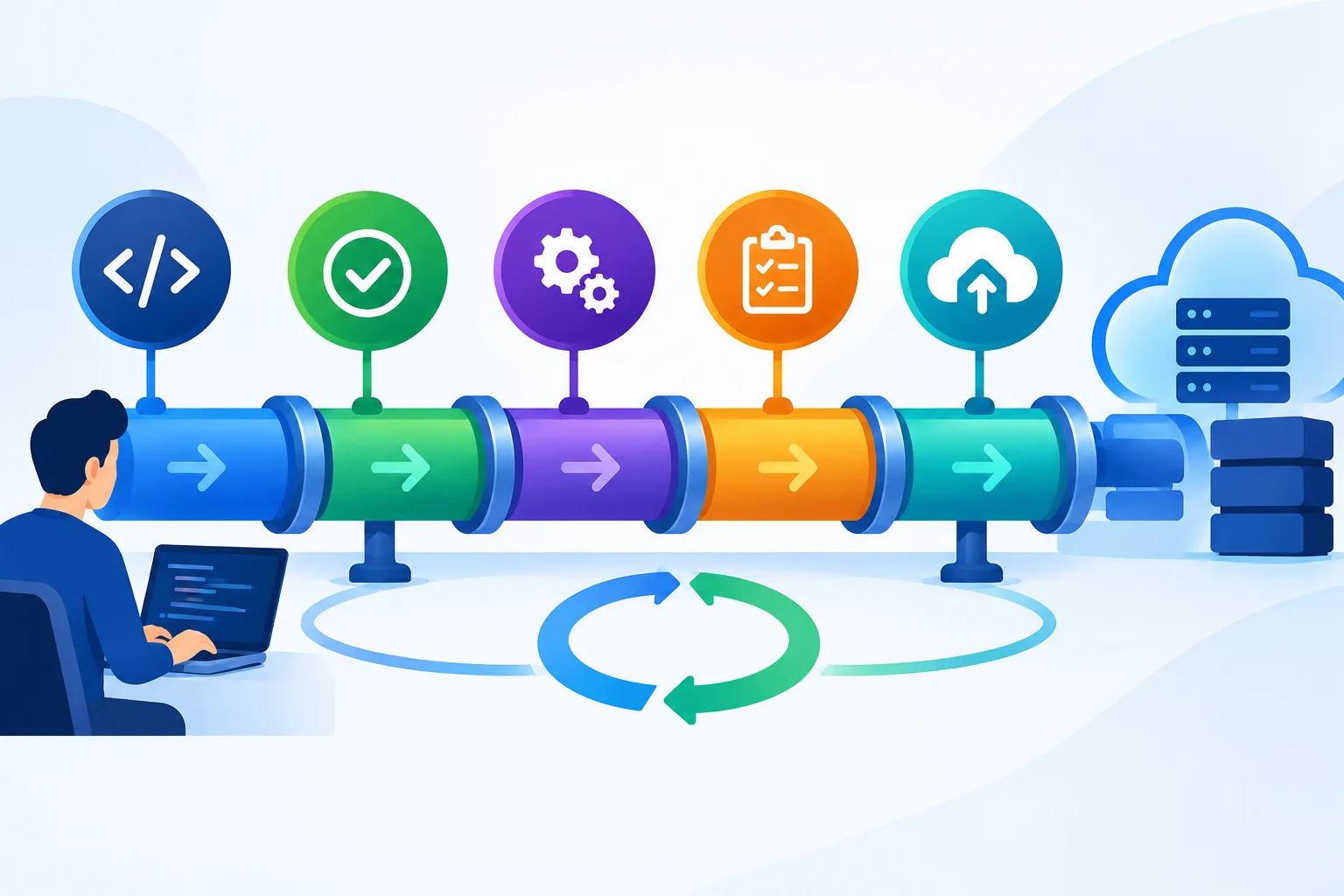
We map out your build, test and release stages based on how your team actually works, then configure the pipeline in the tool you already use - GitHub Actions, GitLab CI/CD, Jenkins, Azure DevOps or Bitbucket Pipelines.

Automated testing integration

Unit tests, integration tests and code quality checks are wired into the pipeline itself, so code is validated before it reaches a shared environment - not after something breaks in front of a user.

Deployment automation

Releases to cloud, on-premise or hybrid infrastructure are scripted and repeatable, removing the manual steps that cause inconsistent deployments between environments.

Environment and secrets management

Credentials, API keys and environment-specific configuration are handled through proper secrets management rather than sitting in scripts or shared documents.

Pipeline monitoring and alerting

Failed builds and failed deployments trigger alerts immediately, so issues are caught by the team, not reported by a customer.

Existing pipeline audit and rebuild

If you already have CI/CD but it's unreliable, undocumented, or too fragile to touch, we review what exists and rebuild the parts that are putting releases at risk.

Specialized pipeline scenarios

Not every setup is a straightforward web application release. Situations we regularly design for:

Multi-environment release paths - separate pipelines and approval gates for development, staging and production, so nothing reaches customers without the right checks.

Compliance-sensitive workloads - additional approval steps, audit logging and change tracking for applications handling financial or personal data.

Mobile app release automation - automated build, signing and store submission steps for iOS and Android releases.

Containerized and microservice deployments - pipelines that build, test and deploy multiple interdependent services without releasing them out of sync with each other.

Infrastructure-as-code integration - pipelines that provision or update infrastructure alongside the application code, so environments stay consistent.

DEPLOYMENT METHODS

Manual vs. CI/CD Automation

A practical comparison of traditional deployment and automated CI/CD workflows.

Factor Manual Deployment CI/CD Automation
Consistency Depends on the person doing it Same steps, every release
Speed Slower, especially under pressure Minutes, on demand
Testing Often skipped when time is short Runs automatically, every time
Rollback Manual, stressful, error-prone Scripted and fast
👥 Team dependency Relies on specific individuals Documented and shared across the team
Visibility Limited, after the fact Logged and alerted in real time

Who We Build Pipelines For

Fintech and banking-adjacent platforms

additional approval gates, audit trails and careful handling of deployment credentials for applications where a release mistake carries financial or regulatory weight.

Retail & facilities operators

E-commerce and retail platforms

deployment automation that avoids downtime during peak trading periods, with fast rollback if a release introduces an issue.

Government and public-sector digital services

controlled, documented release processes suited to systems that need clear accountability and change records.

Startups and growing dev teams

a lightweight pipeline that scales as the team and codebase grow, without overengineering it for a five-person team.

Logistics & trading

Logistics and telecom platforms

pipelines built around multiple integrated services, where one failed deployment can affect several dependent systems at once.
How a Lyqa Tech CI/CD Project Runs

Technical assessment

we review your current codebase, infrastructure, and however releases happen today, including any existing automation.

Pipeline design

stages, environments and approval gates are mapped out to match your actual release process, not a generic template.

Implementation in a safe environment

the pipeline is built and tested against a non-production environment first, so nothing is validated directly against live systems.

Controlled rollout

we move the pipeline into production with a tested rollback path already in place.

Documentation and handover

your team receives clear documentation so the pipeline doesn't depend on us, or on any single person, to keep running.

Ongoing support

ongoing support as your stack, team and release frequency evolve.

Request a Technical Pipeline Assessment

Tell us what you're deploying, how often, and how releases currently happen, and we'll tell you what actually needs to change before we quote anything.

What Drives the Cost of CI/CD Setup in Oman

We don't publish fixed prices, because the real number depends on your setup. The variables that actually move it:

Number of environments - a simple dev/production split costs less to automate than dev, staging, UAT and production run separately.

Existing automation - starting from nothing is different work than repairing a pipeline that's partly built.

Testing depth required - basic build checks versus full automated test suites and quality gates.

Integration complexity - how many services, databases and external systems the pipeline needs to coordinate.

Compliance and approval requirements - additional audit logging and sign-off steps add engineering time.

Infrastructure target - cloud, on-premise and hybrid deployments each carry different setup considerations.

Designing for How Teams in Oman Actually Operate

Infrastructure Control

Flexible Deployment Options

Cloud Connectivity

Frequent Deployments

Why choose Lyqa Tech Ventures

10+ years in IT solutions, ELV systems, and cybersecurity - CI/CD sits within a broader technical practice, not as a standalone service bolted on

A certified technical team handling design through to ongoing support, not a hand-off to a subcontractor

We build around the tools you already use, rather than requiring you to adopt new ones

Local service coverage across Muscat, Sohar, Salalah, and Duqm

Positive feedback from businesses and organisations we've worked with across Oman

Service areas

Lyqa Tech deliver and support CI/CD and DevOps automation services across Muscat (head office, Bousher), Sohar, Salalah, and Duqm.

Our Clients

Request a Technical Pipeline Assessment

Tell us what you're deploying, how often, and how releases currently happen, and we'll tell you what actually needs to change before we quote anything.

Frequently Asked Questions

Do We need to switch tools to work with you?

No. We typically build around whatever you already use – GitHub, GitLab, Jenkins, or Azure DevOps – rather than requiring a migration.

Yes. Most engagements start with an assessment of what exists, and we repair or replace only the parts that are actually causing problems.

It depends on the number of environments and services involved, but most projects run from one to a few weeks after the initial assessment.

A properly built pipeline includes a tested rollback path, so a bad release can be reversed quickly rather than becoming a prolonged incident.

Yes – documentation and ongoing support are part of every engagement, so the pipeline doesn’t depend on any one person to keep running.