Biometric Access Control Systems in Oman
Fingerprint, face, palm vein and iris access control – designed for Omani sites, Omani conditions and Omani data protection rules. A biometric access control system grants entry by verifying a physical characteristic – a fingerprint, face, palm vein pattern or iris – instead of a card or PIN. The reader converts that characteristic into a mathematical template, compares it against enrolled templates, and releases the door only on a match. Because the credential cannot be lent, lost or cloned, every entry is attributable to a specific person.
Accuracy, explained without the marketing
FAR and FRR - the trade-off nobody explains
FAR (false acceptance) is your security risk. FRR (false rejection) is your staff-frustration risk. They move in opposite directions as you adjust the matching threshold - so a quoted FAR figure means nothing without the threshold and the corresponding FRR. Ask for both, and for the failure-to-enrol rate, which on an industrial site decides your modality.
On anti-spoofing: "liveness detection" is a marketing phrase. The technical term is presentation attack detection, evaluated under ISO/IEC 30107-3. Ask which attacks were tested - printed photos, screen replays, silicone moulds, lifted prints - and at what level.
What a biometric access control system actually does
A card says this card was presented. A biometric reader says this person was present. That difference is the entire value proposition, and everything else follows from it.
A complete system has four parts: the reader at the door, the controller that decides whether to release the lock, the locking hardware and door furniture, and the software that holds the rules, the enrolment database and the audit log. Get any one of the four wrong and the system underperforms regardless of how good the reader is.
This distinction drives cost, speed and accuracy more than any brand choice.
1:1 verification - the user presents a card or enters an ID, then presents their biometric. The system compares one template against one stored template. Fast, very accurate, scales indefinitely.
1:N identification - the user simply presents their biometric and the system searches the entire enrolled population for a match. More convenient, and the format most people picture. But matching time and error probability both grow with database size.
For a 40-person office, 1:N is comfortable. For 2,000 workers streaming through a gate at 06:00, the design conversation changes completely - either the matching happens on a device engineered for that population size, or you move to 1:1 with a card, or you add lanes. This is the single most common design error we correct in tenders.
Life safety: how the system must behave in an emergency
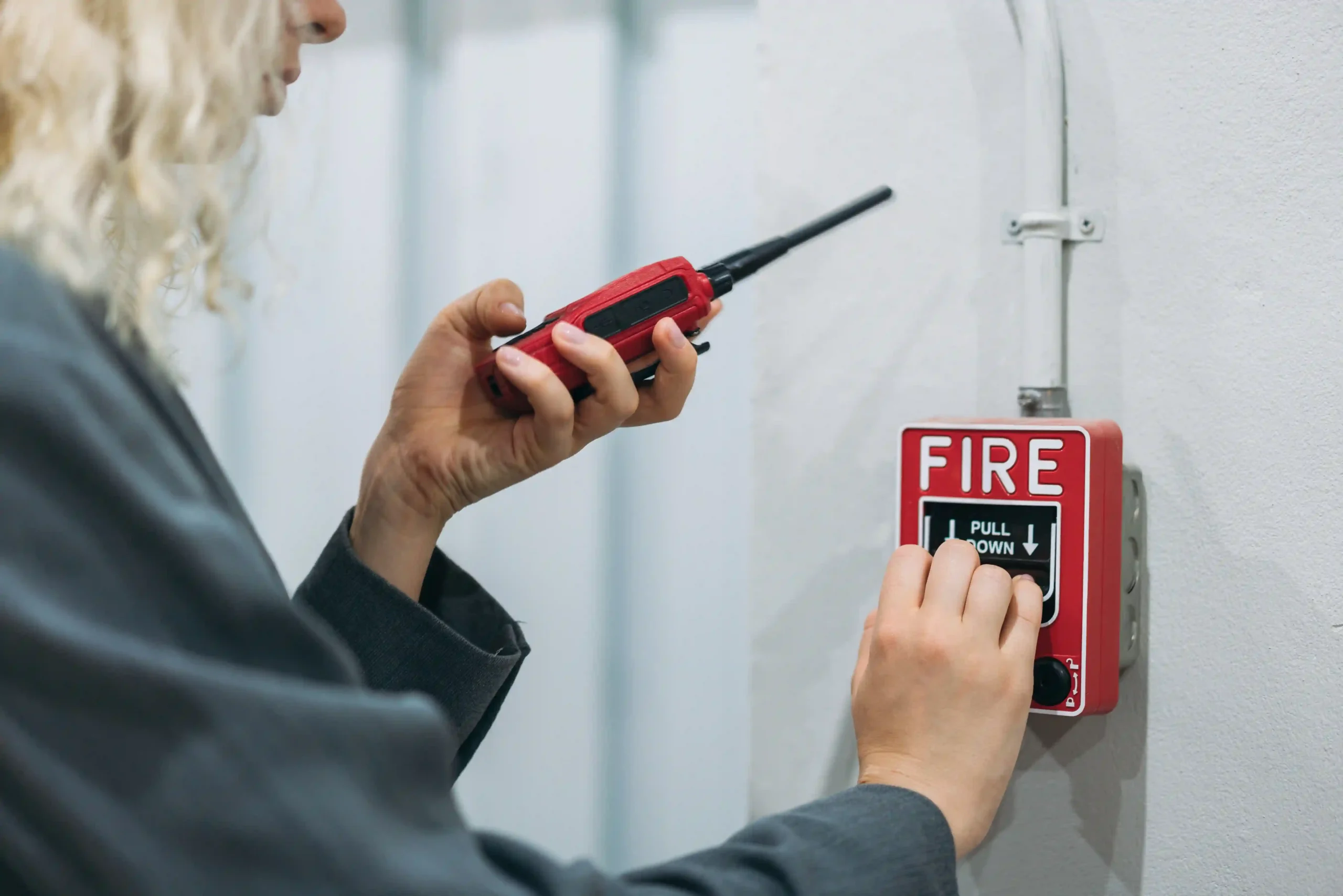
Access control restricts entry. It must never restrict escape. Doors on escape routes release on fire alarm, with fail-safe locking, request-to-exit devices and break-glass units on the egress side.
The fire alarm interface is hardwired and tested, not a software integration - it has to work with the server offline. We test it at commissioning with you present and document the result. Confirm requirements with Civil Defence and your fire consultant early; retrofitting egress after the fact is expensive.
Choosing the right biometric:
fingerprint, face, palm vein or iris
Fingerprint
The workhorse. Fast, economical, right for offices, retail and most internal doors. Its weakness is skin condition: worn ridge detail on industrial workers, wet hands, oil and grease, and dry skin in heavily air-conditioned offices all reduce read quality. Capacitive sensors and multi-finger enrolment solve most of it.
Face recognition
Best where hands are full, hygiene matters, or throughput is the constraint. Users walk up and the door releases. The engineering issues are lighting and mounting: a reader facing a glass lobby at 07:00 with the sun behind the user needs near-infrared illumination and proper shading, or you'll have a queue by week two.
Palm vein
Reads the subsurface vascular pattern, so surface skin condition is irrelevant and the pattern only exists in living tissue. Strong fit for healthcare, labs and food processing. Higher unit cost.
Iris
Extremely low false-acceptance rates, works through glasses. Right for vaults and data centre cages; wrong for a main staff entrance, where cost and positioning time slow the queue.
When biometrics isn't the answer
Very high-turnover contract workforces, where enrollment overhead outweighs the benefit; public-facing doors with unenrolled users; and low-consequence doors that simply don't need it. We'll tell you at the survey stage.
Reader-to-controller security: why Wiegand is a weak link
You can buy an excellent reader and still have a system that opens to a cheap device.
Wiegand - still the default across much of the installed base - is unencrypted and unsupervised. Someone reaching the cable behind a reader can capture or replay a credential and bypass the biometric entirely.
OSDP with Secure Channel fixes this: encrypted, authenticated, supervised communication. That's our standard on new installations. Note that OSDP-capable hardware often ships with Secure Channel disabled - worth asking your current integrator whether yours is switched on.
Attendance, payroll and workforce records
Shift rules crossing midnight, Ramadan hours, overtime thresholds and split shifts configured in the system rather than fixed by hand each month. A documented approval workflow for missed punches - otherwise exceptions become manual overrides and the record loses integrity. A defined payroll or HRMS export agreed at design stage, not discovered at go-live. Multi-site consolidation across Muscat, Sohar and Salalah in one view.
Accurate records also make Oman Labour Law (Royal Decree 53/2023) workforce reporting easier to evidence - though they don't discharge those obligations by themselves.
Integration with your existing systems
CCTV and video analytics (every access event linked to video - investigations take minutes, and it's the only reliable way to catch tailgating), fire alarm, payroll and HRMS, visitor management with auto-expiring credentials, lift and turnstile control, BMS occupancy, and directory services for automated deprovisioning when HR marks a leaver.
That last one matters most. Almost every organisation grants access reliably and removes it unreliably.
Who this is for - sectors and applications
How we deliver a biometric access control project
Survey
doors counted, throughput measured, environment assessed, escape routes identified, workforce composition understood.
Design
door-by-door schedule with modality, hardware, cabling, architecture and data protection implications in writing.
Supply and staging
hardware pre-configured before it reaches site.
Installation
first fix (containment and cabling) and second fix (devices, panel, terminations), sequenced around your operations.
Commissioning
enrolment quality checked person by person, thresholds set and documented per door, fire alarm release witnessed, administrators trained.
Handover and AMC
as-builts, configuration record, escalation contacts, preventive maintenance and firmware updates.
Talk to an engineer, not a call centre
If you know how many doors you have and roughly how many people need access, we can give you a realistic scope and budget shape quickly. If you are earlier than that - still deciding whether biometrics is the right answer at all - a site survey will tell you, including if the answer is no.
What drives the cost
The three biggest variables, in order: door count, cabling (a finished occupied building costs far more than an open fit-out), and whether turnstiles or barriers are in scope - which can exceed the cost of every reader combined. Modality matters less than buyers expect; the gap between a fingerprint and a face reader is usually smaller than the door hardware beneath it.
Also in the mix: environmental specification, user numbers and licensing model, locking hardware, controllers and UPS sizing, integrations, number of sites, and data protection support.
On total cost of ownership, budget for the AMC, software renewal, security patching, sensor cleaning, re-enrolment as staff turn over, and spares for critical doors. A cheap reader with no patching route isn't cheap. Tell us door count, building status and whether barriers are in scope, and we'll give you a budget shape on the phone.
Designing for Omani conditions
Heat and sun
Dust
Coastal humidity and khareef
Heat and sun
Why work with Lyqa Tech Ventures
One integrator across the stack - access control, CCTV Cameras, fire alarm, BMS, telephony, structured cabling, IT and cybersecurity. Integration points handled by one accountable party, not negotiated between three contractors.
Design led by site conditions, not a catalogue.
Data protection built into the design - permit, consent, retention and hosting raised in writing before hardware is ordered.
Coverage across the Sultanate - Muscat, Sohar, Salalah, Duqm, with support arrangements defined per site.
Request a fire alarm site survey
Tell us the building type, approximate floor area and whether you have an existing system, and we will tell you what your building actually needs before we quote anything.
Frequently Asked Questions
Is biometric attendance legal for employees in Oman?
It is permitted, but it is regulated. Under the Personal Data Protection Law and its Executive Regulation, <cite index=”16-1″>processing biometric data requires a permit from MTCIT before processing begins</cite>, alongside consent, policy, record-keeping and breach-reporting obligations. Treat the permit as a project milestone with lead time, not a formality. Confirm your specific position with your legal advisor.
Which is better, fingerprint or face recognition?
Neither, universally. Fingerprint is more economical and excellent indoors with clean, undamaged hands. Face is better for high throughput, hands-full environments, hygiene, and workforces with worn fingerprints – provided the mounting position and lighting are designed properly. On mixed sites we frequently specify both, by door.
What happens during a power cut or network outage?
Correctly designed systems keep working. Controllers hold access rights locally and continue to make decisions without the server; battery backup keeps doors and readers powered for a specified duration; events buffer locally and sync when the network returns. Fail-safe doors on escape routes release. All of this is a design decision – tell us your required standby duration and we will size for it.
Can it work with our existing cards and doors?
Often, yes. Many biometric readers also read cards, allowing a phased migration or a card-plus-biometric configuration on high-security doors. Existing door hardware and cabling can sometimes be reused. A survey tells you what carries over and what does not.
How much does a biometric access control system cost in Oman?
It depends on door count, modality, environmental specification, locking hardware, cabling conditions, user numbers and integrations – see the cost factors above. We provide a fixed-scope quotation after a site survey rather than a headline figure that changes once anyone looks at the doors.
Where is our biometric data stored?
That is a design decision we make with you. Templates can be held on-device, on an on-premise server, or on a cloud platform. If the platform is hosted outside Oman, <cite index=”12-1″>transferring sensitive personal data abroad requires Cyber Defence Centre approval and an assessment of the recipient country’s level of protection</cite>. In-country or on-premise hosting avoids that workstream entirely, which is why we usually recommend it.
Get in Touch
Our vision is to be Oman’s trusted partner for digital transformation.
Visit Us :
Mail Us :
sales@lyqatech.com
Phone Us :
+968 9855 0383